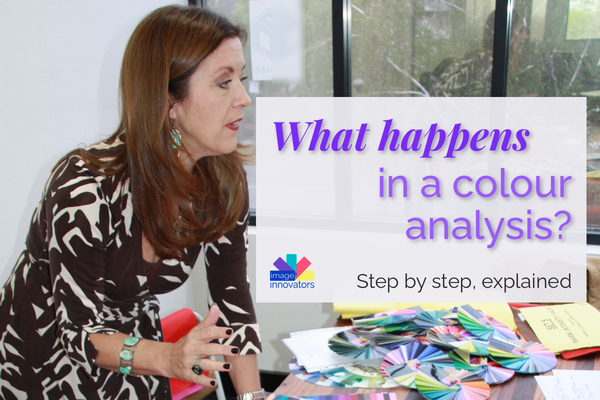
What Happens in a Colour Analysis?
Style Clinic: colour analysis explained
Thinking about booking a colour analysis, or wondering whether you'd love to be the consultant doing them? Either way, it helps to know exactly what goes on in the room. This is one of my favourite topics to teach, so let me walk you through it: what your consultant is looking at, what happens during the draping, and what you leave with.
The short answer A colour analysis looks at how colours interact with your natural hair, skin and eyes. Your consultant compares colours against your face to see whether you are warmer or cooler, lighter or darker, and better in clear or soft colours, then checks your level of contrast. You leave knowing your colour direction, with a swatch of the colours that suit you and your signature colours marked.
What is a colour analysis, in plain English?

Colour analysis is all about how colours interact with your natural features: your hair, your skin and your eyes. The aim is simple. We want the colours you wear to bring out your natural colouring, not compete with it.
When you're wearing the right colours, your eyes look brighter, your skin tone looks more even and you look rested, even after a late night. The wrong colours can cast shadows, drain your complexion and leave you looking tired.
What your consultant is looking at
The colour system we use today looks at three qualities of colour, and your consultant looks for the same three qualities in you.
Temperaturewarm or coolValuelight or darkIntensityclear or softYour starting colour directionone of 12, then personalised for your contrast
Temperature: are there warmer or cooler undertones in your colouring?
Value: how light or dark is your natural colouring overall?
Intensity: are you better in clear, bright colours or softer, muted shades? Soft colouring can be overpowered by strong, clear colours.
Contrast: low, medium or high
Your consultant also looks at the contrast between your hair, your skin and your eyes. It shapes how you wear your colours, not just which ones. I've seen two people with the same colour group who needed to wear their colours quite differently because one had low contrast and the other had medium contrast.
Most people don't fit neatly into four boxes, and that's why we work with 12 colour directions. Your predominant temperature, value and intensity give you a starting point, and your consultant personalises it from there. No one is placed in a colour group because of their cultural or racial background. Anyone can fall into any of the 12.
What happens during the draping
Your natural colouring is the starting point. Your consultant looks at your hair, skin and eyes as they are. Natural hair stays in the picture, because it's part of your colouring.
Colours are compared against your face. Drapes and swatches are held close to your face so your consultant can see which colours make your eyes brighter and your skin clearer, and which ones drain you.
Temperature, value and intensity are worked out. Warm or cool, light or dark, clear or soft.
4Your contrast is checked. This tells you how to put your colours together, for example whether you need some light with dark, or a mid-tone.
5You're given your colour direction and your swatch. Your consultant explains your colours, shows you your signature colours, and talks you through how to use them.
The goal is colours that make you look your best without needing makeup to make them work.

What you leave with
You'll leave with your colours in a swatch, either paper or digital. At Image Innovators our consultants use paper swatches and Your Color ID, our browser-based digital swatch.
Your signature colours. These are the colours in your swatch that look fabulous with you no matter what you're doing. I like to mark mine with little stars. They're the ones worth investing in when you're spending more on something like a jacket or a handbag.
Permission to wear the whole swatch. People sometimes think they should only buy their signature colours. Not at all. You can wear every colour in your swatch, and anything that looks "at home" with it.
A wardrobe that works together. When everything comes from your swatch, your wardrobe becomes one big happy family. The pieces go together, and you stop buying colours you never wear. That saves you time and money.
Tip: use your swatch for contrast, too. Some colours in your swatch will look great on their own. Others need a lighter or darker partner to look their best. If you're wearing a colour from your swatch and thinking "I like it, so why isn't it working?", try adding a colour that brings your contrast back, such as a darker neutral near your face.
Why the trained eye still matters
There are plenty of apps that say they'll tell you your colours from a photo. In my experience they generally don't work well, because they're not nuanced enough. When we built our digital swatch, the computer could read warmth, shade, lightness and clarity, but it couldn't capture a colour's luminosity.
Digital draping and calibrated lighting are useful, and I even have a colour calculator my consultants use. But I always tell them to look at the client properly before making an analysis. The trained eye still tells you which colour group you're in.
Try it at home before you book. Put on some gold jewellery, then silver, and see which looks better against your skin. Try a peach or coral lipstick against a cool pink. Then hold a bright white near your face and see what it does to your teeth and eyes. Cool tends to suit silver and pink; warm tends to suit gold and peach. If both work, you're probably a blend, which is exactly what a consultant can sort out for you.
What to look for, and what to ask, before you book
Whether you're choosing a consultant or training to become one, these questions show how a colour analysis is done.
Will you look at me in person, with your own trained eye? An app or a photo alone isn't enough.
Will you keep my natural hair in the picture? If they want to cover it, ask why.
Will you look at my contrast as well as my colour group? It changes how you wear your colours.
Will I know my signature colours? They tell you where to spend your money.
Will I get a paper swatch, a digital swatch, or both? Choose what you'll use when you shop.
Will you show me how to use it? A swatch is only useful if you know how to combine the colours in it.
Want to be the person doing the analysing?
If reading this made you think "I'd love to do this for other people", that's where training comes in. Advanced Multi-Racial Colour Analysis teaches you to read temperature, value, intensity and contrast with a trained eye, and to use professional swatches and digital tools with real clients, whatever their colouring.
Discover Advanced Multi-Racial Colour Analysis
Have a look here: https://study.imageinnovators.com/advanced-colour
Frequently asked questions
Will I need makeup to make my colours work?
No. The aim of a colour analysis is to find colours that make you look your best without makeup. If a colour only works once you add the "right" lipstick, it isn't your colour.
Do I need to cover my hair during a colour analysis?
Not if it's your natural colour, or the colour you'll be keeping. Your hair is part of your colouring, so it should stay in the picture. It only makes sense to take it out of the picture if it has been coloured in a shade that doesn't suit you.
Can I wear colours that aren't in my swatch?
Yes. You can wear whatever you like, and if it makes you feel good, wear it. When it matters, such as an important meeting, keep it to your level of contrast, keep the colour to less than 20% of your outfit, wear it away from your face, and let your personality carry it.
What are signature colours?
Signature colours are the colours in your swatch that look fabulous with your hair, skin and eyes in any situation. They're the ones to choose when you're investing in a bigger piece. You can still wear every other colour in your swatch.
Can an app do my colour analysis?
Apps and digital tools can help, but they aren't nuanced enough on their own. A trained consultant looks at you properly and picks up the subtleties in your hair, skin and eyes that technology can miss.
The bottom line
A colour analysis isn't about rules you must follow forever. It's about understanding your own colouring, so you can choose colours that work with you and get dressed knowing everything goes together.
Have you had your colours done? I'd love to know what surprised you most.
Clare Maxfield AICI CIP, CEO, Image Innovators
